
Product image coming soon
Motor Driver Module
Dual H-Bridge DC/Stepper Driver
Dual H-bridge motor driver module for DC motors and stepper motors. Connect via GPIO header to control speed and direction. Suitable for robotics projects, c...
Ships within 4–5 business days
Buy NowSKU: MOTOR-HB
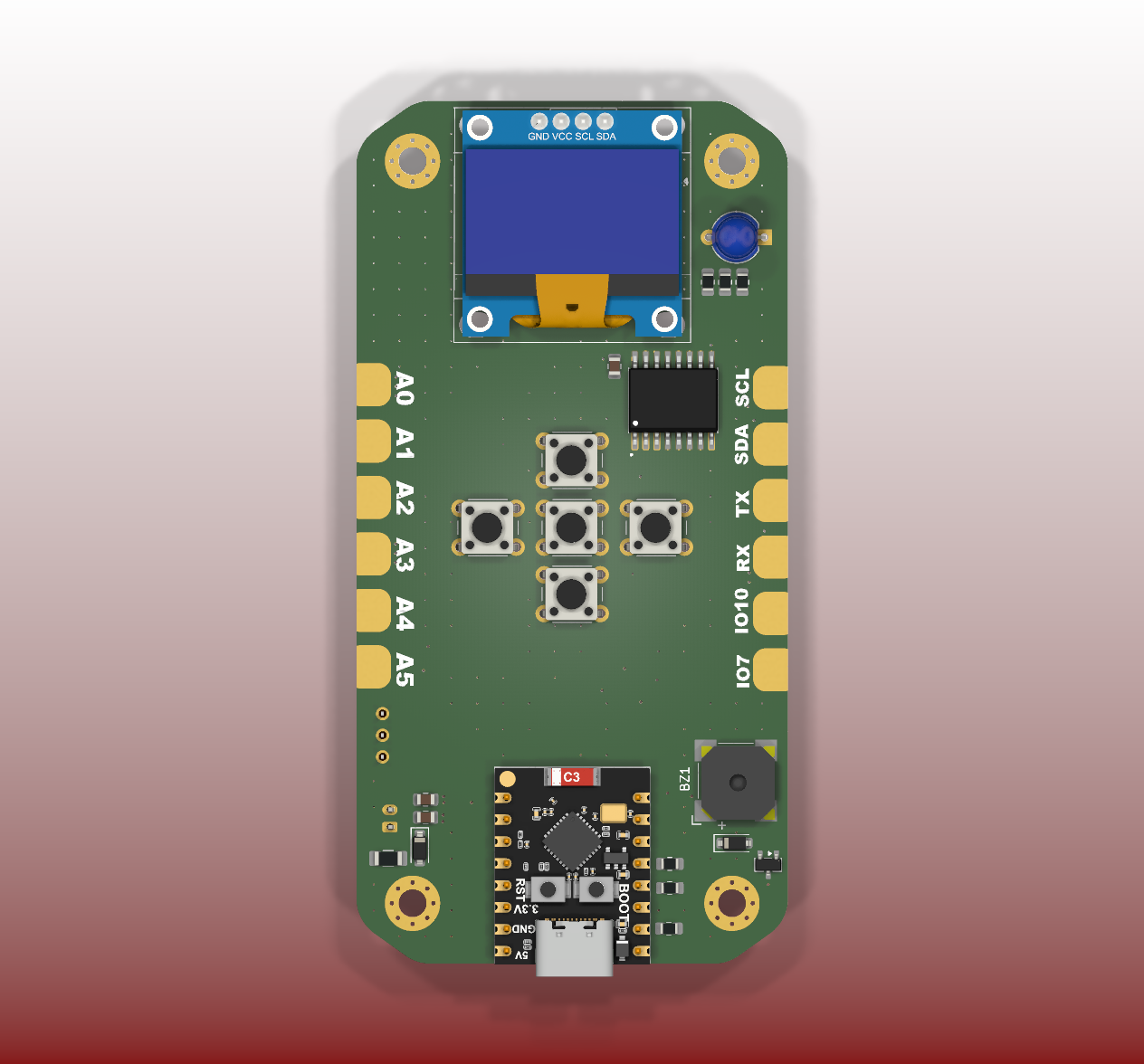
A development board designed for education — not adapted from something else.
Most educational electronics start with a generic dev board and add complexity. BasicEDU was designed the other way: start with the learning experience, then engineer the hardware to support it.
Every component on the PCB has a teaching purpose. The OLED gives instant visual feedback. The buttons enable interactive projects. The buzzer makes abstract concepts audible. Assembling the through-hole components is part of the learning experience — guided by the Quick Start Guide.
Built around the ESP32-C3 — a modern RISC-V microcontroller with Wi-Fi and BLE — BasicEDU takes students from blinking an LED to building wireless connected devices on the same piece of hardware.
SMD Pre-Soldered
SMD components ready. Through-hole parts assembled by you — as a learning step.
Grows With You
From LED blink to wireless sensors — one board, no replacement needed.
Expandable
GPIO, I²C, UART breakouts. Connect sensors, motors, and modules.
Classroom Ready
Designed for schools. Quick start guide, no setup complexity.
What You Can Build
Projects that teach real engineering concepts — from beginner to advanced.
Traffic Light Simulator
Digital I/O, timing, state machines, RGB LED control.
Reaction Timer
Button input, display output, timing functions, user interaction.
Weather Station
I²C sensors, data logging, display formatting, Wi-Fi.
Digital Safe
Input handling, servo control, state logic, security patterns.
Motion Alarm
Sensor input, buzzer output, interrupts, event-driven logic.
Mini Game Console
Graphics, game loops, input handling, sound, state management.
Learning Journey
One board. A continuous path from absolute beginner to embedded developer.
1. Hello World
Upload your first program. Blink the onboard RGB LED. Learn what code, compile, and upload mean.
2. Input & Output
Read button presses. Control the OLED display. Understand digital I/O and logic.
3. Sound & Feedback
Generate tones with the passive buzzer. Create melodies. Learn about PWM and frequencies.
4. Display Graphics
Draw shapes, text, and simple animations on the OLED. Introduction to graphics programming.
5. Sensors & Data
Connect external sensors via I²C. Read temperature, humidity, distance. Log data. Make decisions based on real-world input.
6. Wireless & IoT
Use Wi-Fi and BLE. Send sensor data to the cloud. Build a web dashboard. Create connected devices.
7. Capstone Projects
Combine everything. Build a weather station, a game console, a robot controller. Your own design, from scratch.
Technical Specifications
Verified hardware details. No invented numbers.
Downloads & Resources
Datasheets, guides, and example projects.
Datasheet
Complete technical specifications and electrical characteristics.
Quick Start Guide
Step-by-step setup — from unboxing to first upload.
Example Projects
Ready-to-run code for LED blink, buttons, OLED, buzzer, Wi-Fi.
Pinout Diagram
GPIO map, I²C addresses, pin functions reference.
Frequently Asked Questions
BasicEDU is designed for ages 12 and up. The included Quick Start Guide provides a clear path for beginners. Experienced students and professionals can use the full ESP32-C3 platform for advanced projects.
Yes. BasicEDU is compatible with Arduino IDE, PlatformIO, and ESP-IDF. Board definitions and example projects are provided for each environment.
Yes — the through-hole components are assembled by the student. Buttons, buzzer, and pin headers require basic soldering. SMD components (ESP32-C3, OLED, RGB LED, passives) arrive pre-soldered and tested. The Quick Start Guide includes step-by-step soldering instructions. This is an intentional part of the learning experience.
Yes. Educational discounts are available for orders of 10+ units. Each board includes a printed Quick Start Guide in English and Latvian. Contact us for a quote.
No. BasicEDU includes a JST 2-pin connector for external battery power but does not have an onboard charger. The intended battery option is a 4× AA alkaline holder. USB-C provides power for programming and desktop use.
BasicEDU board, 1 m braided USB-C cable, and printed Quick Start Guide (EN + LV). A component kit with breadboard, jumper wires, LEDs, and resistors is available separately as an optional add-on.
Start building today.
One board. From LED blink to wireless IoT. SMD pre-soldered. Through-hole assembly included as part of the learning experience.
Get BasicEDU — €24.90